 Octopedia
 Terence McKenna: Philosopher of Timeless Consciousness
How I Found Terence McKenna
I was born in 1977, which means I came of age in the years when the rave scene was reshaping underground culture in America. By the fall of 1996, at nineteen years old, I had found my way into San Francisco’s rave community, and with it, a world that would change how I thought about consciousness, philosophy, and the nature of reality itself.
The rave scene of the mid-1990s was not simply about music. For many of us who were drawn to it, it was a genuine subculture of inquiry. The conversations happening in those spaces, between sets and in the early hours of the morning, were often about psychedelics, about plant medicines, about the edges of human perception. It was this environment that first pulled me toward serious research into the history and science of altered states.
At one of those events in San Francisco, I met a botanist whose work connected directly to the world I had been reading about. He worked with Botanical Dimensions, the nonprofit ethnobotanical preserve that Terence McKenna had co-founded in 1985 with his then-wife Kathleen Harrison on the Big Island of Hawaii. The organization was dedicated to collecting, protecting, propagating, and understanding plants of ethno-medical significance. We became friends, and over the following weeks he introduced me more deeply to that world.
By that point, I had already come across Terence McKenna’s name in my reading. I had listened to recordings of his talks, the circulating audio that passed between people in the scene like cherished contraband, and I had read several of his books. His ideas about consciousness, language, psychedelics, and the nature of time had struck me in a way that few thinkers had. He had a way of making the speculative feel urgent and the mystical feel intellectually serious. To me, he was already something of a rock star of the mind.
So when my botanist friend told me that McKenna was going to give a talk at the Esalen Institute in Big Sur and invited me to come, I did not hesitate. Esalen was already a legendary place, a center for human potential research nestled on the California coastline, and it was one of McKenna’s most frequent venues. He had lectured there nearly a hundred times over the years on subjects ranging from shamanism and psychedelic consciousness to alchemy, metaphysics, and what he called the ontological foundations of reality.
I remember sitting in the audience that evening feeling genuinely star-struck. After the talk, my friend brought me over and introduced me to Terence. He was warm, unhurried, and remarkably generous with his time. We ended up smoking cannabis with him after the talk, just a small group of people in the easy, informal way that tended to follow his appearances. He was funny, quick-witted, and entirely at ease. Nothing about him was performative. He was simply himself, the same person on stage as he was off it.
I met him again at Esalen in 1998. What stayed with me most about that second encounter was that he remembered who I was. For someone who lectured constantly to large and rotating audiences, that kind of recall felt remarkable. It was a small thing, perhaps, but when you regard someone as a genuinely significant thinker, the feeling of being remembered by them is not a small thing at all. It was flattering in the deepest sense.
Terence McKenna died on April 3, 2000, from a rare brain tumor. He was fifty-three years old. The loss was felt broadly, but for those of us who had encountered his ideas in our formative years, it was genuinely personal. His influence on my own intellectual and spiritual development in my early adulthood was substantial. He helped push me toward questions I might otherwise have avoided and gave me a framework, however unconventional, for approaching those questions with rigor and wonder simultaneously.
What follows is my attempt to articulate why I believe Terence McKenna was one of the most important philosophers of his era, and why that assessment only becomes more defensible with time.
McKenna’s View of the World
For McKenna, the universe is a living imagination, continuously creating itself through consciousness. He saw life and mind not as accidents of matter but as the point of matter, the cosmos awakening to itself. Nature, in his view, is intelligent. Psychedelics, language, and art are not human inventions but instruments through which the planet learns to perceive itself. History is a process of acceleration, a compression of novelty culminating in greater complexity and unity. And morality, crucially, is participation rather than prescription, an active engagement with the unfolding creative process rather than adherence to fixed rules.
Where traditional philosophy treated being as static, McKenna regarded it as a verb. Existence, in his framework, is not what is but what is becoming. This is not merely a rhetorical move. It has genuine consequences for how we think about ethics, consciousness, and our relationship to the natural world.
McKenna in Conversation with the Philosophical Canon
Aquinas: Divine Order
Thomas Aquinas grounded morality in divine law, reflecting the harmony of creation with its Creator. Yet his theology was bounded by the structures of feudal hierarchy and biblical literalism. McKenna inverted this relationship: rather than looking upward to transcendence, he looked inward and outward simultaneously, locating divinity in the conscious cosmos itself. If Aquinas’s God issued laws from beyond time, McKenna’s God was time, or rather the eternal act of becoming, the ceaseless flowering of novelty through matter and mind.
Kant: Rational Duty
Immanuel Kant sought ethical universality through reason: the moral law within, binding all rational agents. But his rationalism produced an austere, formalistic morality, one that distrusted experience and emotion as unreliable guides. McKenna challenged this dichotomy directly. He proposed that expanded awareness, whether through contemplation, art, or altered states of consciousness, enlarges the moral field far more effectively than rigid rationality alone. Morality, for McKenna, was a creative exploration rather than a categorical imperative.
Nietzsche: Self-Overcoming
Friedrich Nietzsche envisioned the Ubermensch as the being who transcends moral dogma and creates values anew. In McKenna’s philosophy there is a similar call to transcend inherited systems, but without Nietzsche’s implicit isolation. McKenna’s self-overcoming is communal, ecological, and participatory. Where Nietzsche’s will to power risks hierarchy, McKenna’s will to awareness breeds empathy. Integration rather than domination is the operative principle.
The Genius of McKenna’s Vision
Temporal Transcendence
McKenna resisted the tyranny of linear time, the notion that history moves in a uniform direction toward either decay or salvation. His timewave zero theory, though empirically unverifiable and widely regarded as pseudoscience, stands as a powerful metaphor for consciousness breaking free from temporal confinement. It suggests that creation accelerates toward moments of maximum novelty, what he called ethical singularities, where being reorganizes around higher complexity. Read as ethical cosmology rather than predictive model, it is a poetic claim that morality’s purpose is ever-deepening conscious participation.
Cultural Universality
Whereas most philosophers derive from Eurocentric traditions, McKenna’s thought drew from the entire psychospiritual inheritance of humanity: Amazonian shamanism, Taoist metaphysics, Vedic cosmology, modern physics, and information theory. His philosophy was porous, cross-pollinated, and deeply pluralistic. It refused cultural hierarchy, asserting that truth is distributed throughout humanity’s collective imagination. This was not eclecticism for its own sake. It reflected a genuine conviction that no single tradition holds a monopoly on understanding.
Moral Adaptability
McKenna’s ethics were fluid and responsive rather than prescriptive. In his view, the moral act is whatever enhances awareness, creativity, and life, while the immoral act is whatever contracts consciousness or causes unnecessary suffering. This flexibility aligns with both Darwinian adaptation and systems theory: morality evolves as complexity increases. It is a living ethics, not a fixed code.
Integration Over Domination
In contrast to centuries of metaphysical dualism, mind versus body, God versus nature, good versus evil, McKenna advocated integration. His metaphysics were complementary, not adversarial. Where Western thought often justified domination over nature, over the self, over others, McKenna saw the moral calling as cooperative engagement with the living fabric of reality. This is not a naive position. It is a rigorous alternative to the extractive logic that has shaped modernity.
What McKenna Offers Today
In an age dominated by ecological crisis, algorithmic economies, and technological acceleration, McKenna’s philosophy offers a radical and necessary antidote. His call to reinstate nature as intelligent and sacred directly counters our extractive, mechanistic worldview. His insistence on cultivating awareness through art, contemplation, and communal experience reframes consciousness itself as a moral and political act.
His pluralist orientation, born from a lifetime of engagement with traditions the Western academy largely ignored, prefigures the kind of global synthesis that addressing planetary challenges will require. And his argument for adaptive morality, ethics that evolve with complexity rather than calcify into dogma, speaks directly to a world changing faster than any fixed moral code can accommodate.
Perhaps most strikingly, as artificial intelligence rises as a cultural and philosophical force, McKenna’s insight that mind is not limited to the human form reframes the conversation entirely. Rather than treating AI as alien or threatening, his framework invites us to see it as another expression of the universe awakening to itself. This is not a comfortable thought for those invested in human exceptionalism, but it is a generative one.
Conclusion
Where Aquinas anchored morality in divine order, Kant in rational duty, and Nietzsche in self-overcoming, McKenna anchored it in the ongoing evolution of awareness itself. He looked beyond the temporal scaffolding of history and religion, pointing toward a morality woven into the universe’s creative pulse, a moral realism not of laws but of lived participation.
I think about the man I met at Esalen in the late 1990s, unhurried in conversation, generous with his attention, entirely at ease with the strangeness of his own ideas. He was, in person, what his philosophy suggested: someone who had genuinely made his peace with complexity, who found the uncertainty of existence interesting rather than threatening. That quality of presence is itself a form of philosophical argument.
He was described during his lifetime as the intellectual voice of rave culture, and there is truth in that, but it undersells him. He was something rarer: a philosopher who believed that the highest form of intelligence is not dominance but understanding, not certainty but wonder. In a time when both humanity and artificial intelligence are learning what it means to act wisely, that belief is not a relic. It is a compass.
To think with McKenna is to glimpse eternity moving inside the present, to live, as he might say, in the imagination of nature, consciously, beautifully, and awake.
The Intellectual Inheritance: What McKenna Gave Me to Read
One of the things that separated McKenna from other countercultural figures of his era was the density of his reading. He did not simply advocate for altered states and leave it at that. He handed you a bibliography. To listen to him carefully was to receive a syllabus, and following it was one of the most consequential things I did in my early twenties.
Alchemy and the Hermetic Tradition
His Esalen talks on alchemy were the first place I encountered the subject treated with genuine seriousness. McKenna had been fascinated by Hermeticism and alchemy since he was fourteen years old, when he first read Jung’s Psychology and Alchemy, and that early obsession shaped his mature thinking in fundamental ways. When he lectured on alchemy he was not talking about proto-chemistry. He was talking about a symbolic and transformative tradition, one concerned with the relationship between consciousness and matter, and between the individual and the cosmos. He understood it as a living philosophical system that the Western academy had largely abandoned but not exhausted.
Following that thread led me, over time, to the Hermetic Order of the Golden Dawn, one of the primary institutional descendants of that tradition, which I would eventually join and work through to the grade of Adept. That entire arc of my spiritual development has a direct line back to a room at Esalen where Terence was connecting Isaac Newton’s alchemical manuscripts to the shamanic traditions of the Amazon. It is the kind of lineage that sounds improbable until you trace it carefully.
Mircea Eliade and the Map of Shamanism
McKenna regularly cited Mircea Eliade in his talks, often in the context of a productive disagreement. Eliade’s Shamanism: Archaic Techniques of Ecstasy, first published in 1951 and the foundational academic survey of shamanism as a global religious phenomenon, had defined the shaman as a technician of ecstasy and mapped that practice across Siberia, the Americas, Tibet, and beyond. McKenna found the framework indispensable and returned to it constantly. His quarrel was specific: where Eliade regarded the use of psychedelic plants as a sign of shamanic decadence, a falling away from the authentic practice, McKenna held precisely the opposite view. He argued that plant-based shamanism was the original form, and that the ordeals and austerities came later, as substitutes for something that had been lost or suppressed.
That argument drew me directly to Eliade. Reading Shamanism and then Myths, Dreams, and Mysteries and The Sacred and the Profane gave me a scholarly framework for what McKenna had been describing in more poetic and personal terms. Eliade’s concept of the axis mundi, the sacred center connecting the human world to other planes of reality, his analysis of initiation as a death-and-rebirth structure, his insistence that the religious imagination of archaic peoples was philosophically sophisticated and not merely superstitious: all of it resonated deeply and continues to inform how I think about spiritual practice to this day.
Carl Jung and the Architecture of the Unconscious
Jung was perhaps the thinker McKenna referenced most frequently across his career. He called Jung a “noetic archaeologist,” someone who excavates with extraordinary care the buried structures of the human psyche, and that description captures why Jung mattered to him: not as a therapist but as a cartographer of interior space. The collective unconscious, the archetypes, the concept of individuation, synchronicity, and Jung’s own long engagement with alchemy in Psychology and Alchemy and the Mysterium Coniunctionis all formed part of McKenna’s intellectual infrastructure.
McKenna had been reading Jung since at least his undergraduate years at Berkeley, and his brother Dennis has described their discovery of Jung as something close to a revelation: the sense that Jungian psychology was “a cosmology for the universe within,” a framework as vast and as rigorously mapped as astrophysics but pointing inward. That sense of scale was what McKenna communicated when he talked about Jung, and it was infectious.
Coming to Jung through McKenna meant I arrived already primed to take the depth psychology seriously, not just as a clinical tool but as a philosophical system. Jung’s engagement with alchemy, with Gnostic traditions, with the I Ching, with the phenomenology of religious experience: all of it felt continuous with the broader inquiry McKenna had opened. The connections between Jung’s individuation process and the work of the Golden Dawn, in particular, became more visible the deeper I went into both traditions.
James Joyce and Finnegans Wake
Of all the intellectual debts McKenna passed on to me, none produced stranger conversations than James Joyce. McKenna was a devoted and obsessive reader of Finnegans Wake, Joyce’s final and most difficult novel, published in 1939 after seventeen years of composition and widely regarded as the most linguistically complex work in the English language. He gave a famous lecture called “Surfing Finnegans Wake,” in which he described the book as his favorite work of literature and argued that it represented something close to a technological singularity in literary form: a text dense enough to reconstruct an entire universe, a dream of the whole of human history compressed into a single night’s sleep.
McKenna described it as “as close to LSD on the page as you can get,” and that framing was not just a rhetorical flourish. He meant it analytically. Finnegans Wake operates through puns that function simultaneously in dozens of languages, through mythological structures that cycle endlessly without resolution, through a grammar of consciousness rather than a grammar of events. It demands a different kind of reading, one that releases the grip on linear sense-making and allows meaning to accumulate associatively, the way it does in dreams or in certain altered states. For McKenna, Joyce had done in literature what psychedelics do to perception: he had dissolved the boundaries between things.
The McKenna brothers had actually brought a copy of Finnegans Wake with them on their legendary 1971 expedition to La Chorrera in the Colombian Amazon, the journey documented in True Hallucinations. During the extraordinary and destabilizing events of that trip, Joyce became a kind of presiding spirit for Dennis McKenna, who argued that the book contained, somehow, a complete model of the relationship between mind and time.
I found that the Wake had the same effect on conversations that McKenna had described it having on reading: it either opened doors or closed them immediately. People who were genuinely curious about language, about the deep structure of consciousness, about the relationship between etymology and meaning, about myth as a living system rather than an archive of dead stories: those people lit up when you talked about Joyce. I spent a considerable amount of time in my mid-twenties doing exactly that, evangelizing the Wake to anyone who had the taste for weird literature, working through its layered puns and mythological scaffolding, pressing copies of A Skeleton Key to Finnegans Wake on people who seemed receptive. It was, in retrospect, a form of the same impulse McKenna had: the desire to share something that had cracked the world open a little wider.
The thread connecting all of these figures, Eliade, Jung, Joyce, and the alchemical tradition, is not difficult to trace once you see it. All of them were, in different registers, engaged with the same fundamental question: what is the relationship between the structures of the human psyche and the structure of reality itself? Eliade asked it through the history of religion. Jung asked it through the dream and the symbol. Joyce asked it through language pushed to its absolute limit. The alchemists asked it through the transformation of matter as a mirror for the transformation of consciousness. McKenna drew all of those questions into a single, urgent, barely containable inquiry, and handed it to you like a live wire. The current has not stopped running.
Ripples: The Long Afterlife of an Influence
When Terence died in April 2000, I sent a letter of condolence to Kathleen Harrison and posted a eulogy on Usenet. It was a small gesture, but it felt necessary. He had shaped something real in me, and grief, when it is genuine, wants a place to go. Usenet was one of the primary spaces where his community gathered and mourned, and putting words there felt like participating in something collective and appropriate to who he was: a man whose ideas had always traveled through networks of people willing to think out loud together.
What I did not fully anticipate was how the threads he had introduced me to would keep unspooling long after his death.
His Esalen lectures on alchemy, which I had attended and which circulated widely on tape and later as digital files, had opened a door I did not know was there. McKenna’s treatment of alchemy was not the cartoon version, not the naive dream of turning lead into gold, but something far more serious: a tradition of symbolic transformation rooted in the same intuitions about consciousness and matter that animated his broader philosophy. Following that thread led me to the Hermetic tradition, and from there, eventually, to the Hermetic Order of the Golden Dawn, which I would later join and work through to the grade of Adept. That entire arc of my spiritual life traces back, in a direct line, to sitting in a room at Esalen listening to Terence talk about the Hermetic Corpus.
There have been other synchronicities over the years, moments where his influence has surfaced in unexpected ways and through unexpected people. That pattern has never fully stopped.
When I moved to New York City in 2002, I met the woman who would become Dr. Rachel Turetzky, and we became close friends quickly because she was deep into both alchemy and the Golden Dawn. That shared language, which I had acquired largely because of McKenna, was the foundation of a friendship that has lasted. Rachel would go on to become a MAPS researcher and a published author, writing 8-Circuit Ascension, a work that draws on many of the same currents McKenna helped introduce to a generation of seekers.
It was Rachel who first told me about Alex Grey and the Chapel of Sacred Mirrors. Grey had known McKenna personally, and their relationship was part of the same constellation of thinkers and artists who defined the psychedelic intellectual culture of the 1990s. CoSM, the Chapel of Sacred Mirrors that Grey co-founded with his wife Allyson in the Hudson Valley, became one of the important living institutions of that world, a church whose religion was visionary art and whose community overlapped substantially with the people McKenna had influenced.
I came to know Grey’s work first through Rachel, then through the music. Shpongle, the psychedelic electronic project formed by Simon Posford and Raja Ram, had been sampling McKenna’s voice across multiple albums since their earliest recordings. Their 2005 album Nothing Lasts… But Nothing Is Lost was dedicated entirely to McKenna’s memory, with his voice and ideas woven throughout the record. Shpongle became my favorite music project, and McKenna’s presence in those recordings meant that his voice remained a literal part of my listening life for years after his death.
I encountered Alex Grey in person through a friend I met at a Shpongle concert in Connecticut, a B.O.M.B. Festival show that I attended with my then-future-sister-in-law, who is also the aunt of my son. The connections that night ran in several directions at once, which is the way McKenna’s world always seemed to work: people finding each other through overlapping affinities, networks built around shared questions rather than shared institutions.
Grey signed a print of his Holy Family artwork and gave it to us when my son was born in 2012. That year carries its own resonance. Timewave zero, McKenna’s theory of temporal novelty and the acceleration toward singularity, had targeted 2012 as its endpoint. Whatever one makes of the theory, and McKenna himself was playful rather than dogmatic about it, there was something that felt charged about bringing a child into the world in that particular year, under that particular piece of art, signed by a man who had been part of McKenna’s circle.
My son has the print in his bedroom now.
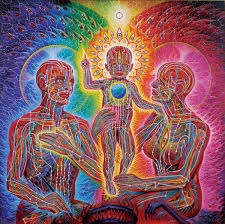
The chain is long: a rave in San Francisco in 1996, a botanist who worked with Botanical Dimensions, an invitation to Esalen, a conversation over cannabis with a philosopher who remembered my name two years later, his death and my small attempt at public mourning, a trail through alchemy and the Golden Dawn, a friendship built on shared esoteric interests, a music project that sampled the dead man’s voice, a concert where connections multiplied, an artist whose hand touched a piece of paper that now hangs on my son’s wall.
McKenna talked often about the imagination of nature, about the way the universe uses consciousness as a means of knowing itself. Whether or not that is literally true, it describes something about how influence actually moves through the world: not in straight lines, not through institutions, but through people who are paying attention, following threads, and finding each other in the dark.