 Octopedia
 Fateful War Memoirs
By Adolfo C. Eufemio, Jr.
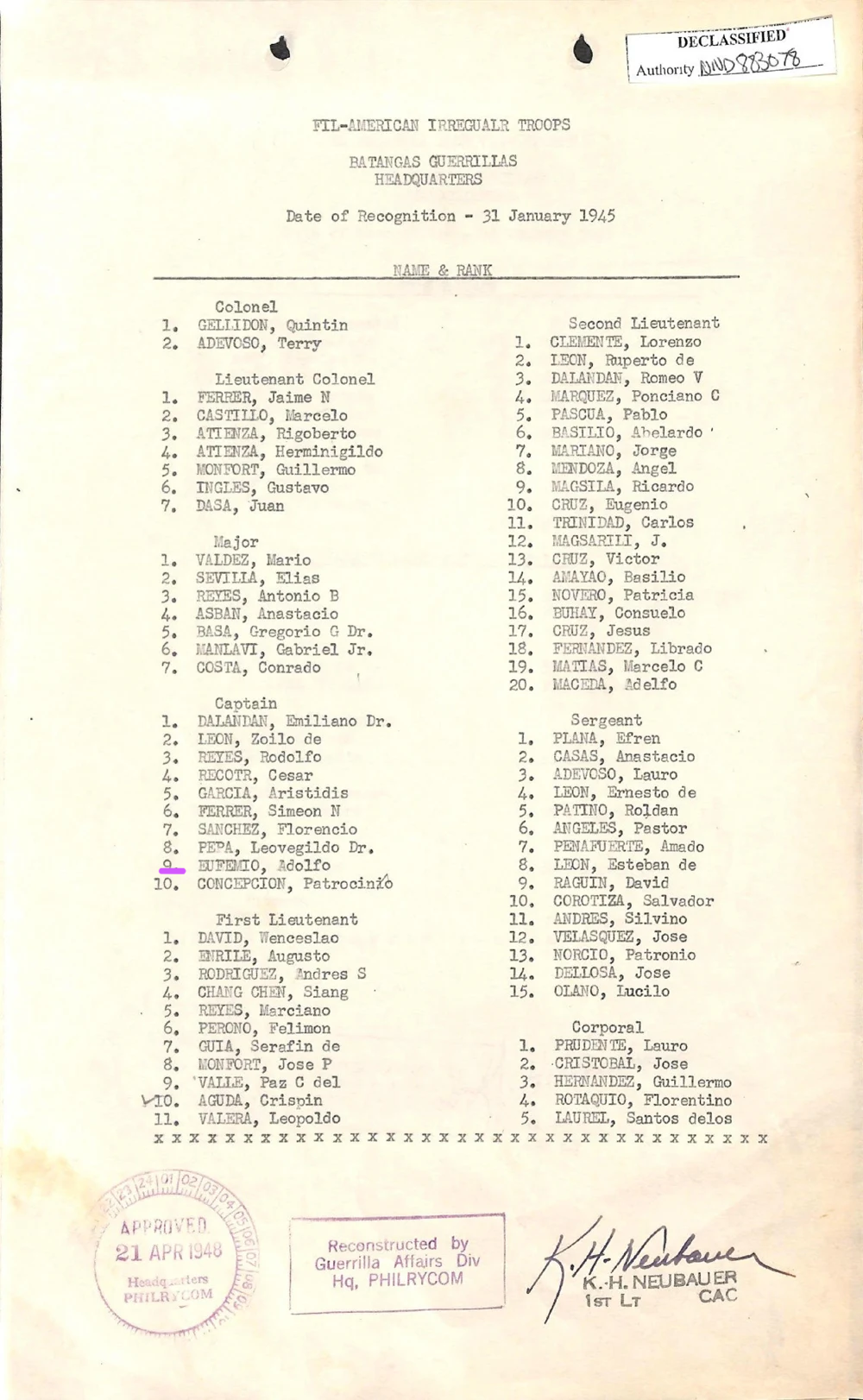
Captain Adolfo Euferio (sic) was released in late July 1942. His captors misspelled his last name. The only difference between my name and his is the “Junior” after our surname, which is correctly spelled as “Eufemio” with an ‘m’ and not an ‘r’.
He joined the Philippine Scouts of the United States Army at the age of 19 on 11 April 1911. His parents could not afford to send him to take up law, a degree which, he earnestly wanted to pursue. He had obtained a Bachelor of Arts (AB) degree on 6 March 1908 at San Juan de Letran. With part of his earnings from the United States Army and whenever he was stationed at Fort Mckinley (now Fort Bonifacio), he enrolled for evening classes at the National Law College of the University of Manila. With his diligence and strong will to accomplish his dream, he managed to finish law (LLB) on 25 March 1926; just two months after I was born.
He was with the Philippine Scouts of the United States Army for almost 17 years where he excelled in shooting. He was a principal member of the Philippine Scouts Team that competed and won medals in international shooting competitions in Camp Perry, Ohio, the former site of Olympic competitions in shooting. In his desire to be a commissioned officer he applied and was finally commissioned and called to active duty as a Third Lieutenant with the Philippine Constabulary on 10 November 1927. As a newly commissioned officer, he was sent as a Student Officer to the Philippine Constabulary Academy, the forerunner of the Philippine Military Academy, in Baguio where he graduated with the class of 1928. He served in the campaign of General Pershing who was then a Major, in Mindanao against the Moro insurgents.
Three years before the bombing of Pearl Harbor, he had passed the bar examination to become a full-pledged lawyer but opted to continue his military career. When his military training had to be put to a real test, there were already five of us children: Natividad, myself, Napoleon, Pilar, and Solomon. He had to leave us with our mother, Rosario, to fight the Japanese Imperial Army.
During the remaining days of December 1941, he was in his headquarters, preparing to leave and join the main bulk of the USAFFE and U.S. Army troops for the defense of Bataan. I had to take on most of his responsibilities for the family when he left us. I then went further and also assumed a military role. I grew up by force of circumstances and later almost outranked him by the end of the hostilities.
We were never together in the battlefields and never really knew what the other was doing until the Liberation. But the records showed that there were two of us; the other was Adolfo, Sr who fought in a war that was provoked by and against forces allied to the notorious Adolf Hitler. Interestingly, there is something common about the names, Adolf, Napoleon and Solomon. They were all names of dominant figures in history, appearing in the reverse order of the sons of Adolfo Sr.
I don’t know about the case of my brothers but obviously, I was named after my father. Like him, I was destined to be a war veteran and later a retired Colonel.
The Initial Dark Months
When the Japanese planes bombed Pearl Harbor on 7 December 1941, I was only 15 and in the last semester of fourth year high school at the Ateneo de Manila along Padre Faura Street, Ermita. My whole family was then residing at 283 Zobel Street, Ermita, near Marquez de Camillas Street, at the foot of the Ayala Bridge. I was with a group of my cousin, Loreto Parto-Bulaclac (Manang Itang) attending a town fiesta on December 8, 1941 at Pasig, Rizal when the Japanese started bombing Manila.
We would hear the siren almost daily, right before the Japanese planes hover above us, and drop the bombs on their targets in Manila and its suburbs. Disregarding my parents’ warning, I would run to the streets to watch the dogfights between the Japanese and the Philippine Airforce planes, who were always out-numbered. There were frequent blackouts. Looting, especially for food became so rampant all over Manila. The sacks of rice and cases of canned goods, which my father brought home from time to time, were his means of saying goodbye to us each time he had a mission to fulfill.
One day, I told my father that I would like to volunteer for war service. He and my mother immediately and vehemently contradicted me. “But you are too young and being the oldest son you take care of your sickly mother, two brothers and two sisters while I am away”, the Captain said. I did not insist and question the order.
In January 1942, we transferred residence to Cavite Street near the North Cemetery of Manila. This was farther away from the probable targets of Japanese bombers. The first floor of our new home was ideally elevated a few feet above the ground. We dug deep under the house and prepared a crude bomb shelter. We would rush down and hide like little mice each time we hear the siren. This was almost always, followed by deafening explosions.
Quite often, we had to eat in the dark, inside our makeshift air raid shelter. I had to queue with my sister Natividad, the eldest child, for so many hours at times to buy rations of whatever food there was. More often, it was just rice and our meals were “trigo” or rice porridge. At times we would sleep in our black hole until the next morning or when the siren would announce that it was safe to come out.
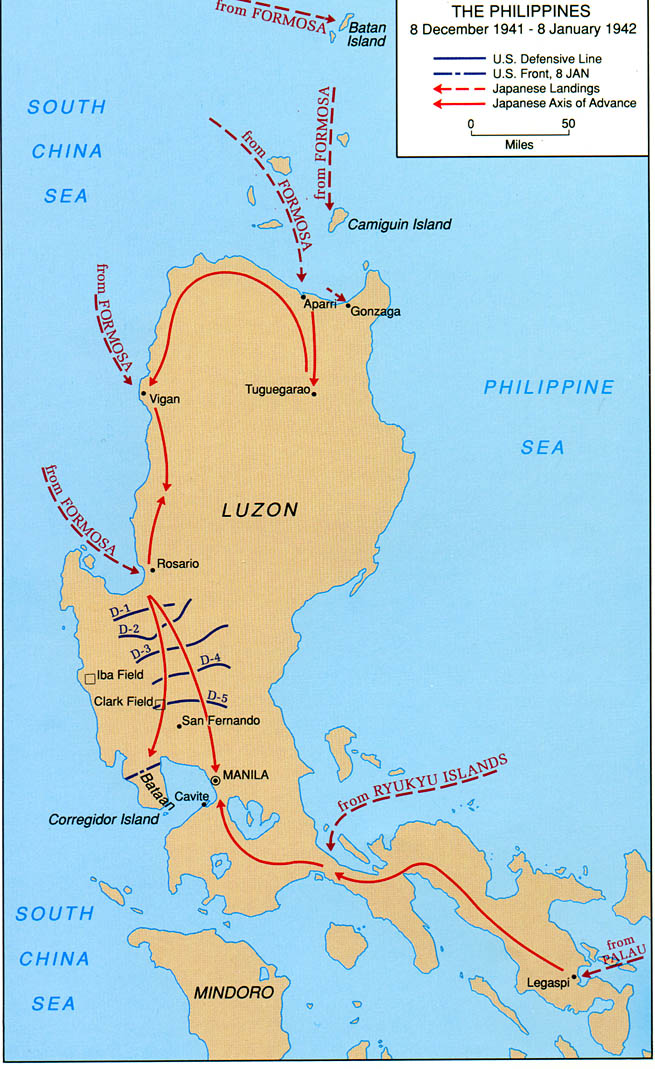
We were all at home when we heard news that the Japanese Army had landed in Lingayen, Pangasinan. They would soon be entering Manila. The Japanese invading forces actually passed right in front of our house some time in February 1942. We shut all our doors and windows.
But we were so curious and decided to peep through the cracks on our windows. This was supposed to be the first time we would see the Japanese soldiers. Some of them were walking while others rode bicycles. Almost all of them wore a beard, looking very mean and filthy. We heard later that they were actually Koreans conscripted by the Japanese for the invasion of the Philippines. Manila was later declared an open city to be saved from further destruction.
My mother purchased a “caretela” (carriage) with two horses and engaged in a small public transportation business. My cousin Augusto Parto, younger brother of Manang Itang, assumed the role of “cochero” (driver) and caretaker of the horses. I was his assistant. When this could not provide us enough money for our daily needs, my mother started selling her unused Ilocano woven blankets, jewelry and other valuables. And when these were all gone, she reluctantly sold one of the two solid gold medals of my father. They had more sentimental than monetary value considering that these were awarded by the US Government when he won in international shooting competitions, as a Sergeant of the United States Army Philippine Scouts.
One late afternoon, I horribly witnessed a Japanese Officer behead a Filipino inside the North Cemetery. He was summarily convicted of looting Japanese stores. Japanese soldiers had inspected his house and found Japanese goods packaged in bulk with still original wrappings.
This gruesome experience made me discard the souvenir Moro weapons accumulated by my father during constabulary campaigns in Mindanao. I feared that the Japanese may discover these items should they suddenly inspect all houses. They may associate this with my father and torture us to reveal his whereabouts. I also hesitantly threw away a saber marked “U. S. Army”, which was given to him when he was still a First Sergeant with the Philippine Scouts, United States Army.
It was in March 1942, when Mariano Taa, husband of Asuncion Catriz, the youngest sister of my mother, found us in Cavite Street. He successfully convinced my mother that we evacuate to the New Bilibid Prison Reservation in Muntinlupa, Rizal. Uncle Mariano was the Chief of the Identification Division of the New Bilibid Prison and was provided government housing in the area. With everything we had including the Moutrie piano purchased eight years ago for my sister, we transferred to the house of my mother’s relatives in Muntinlupa, where the six of us occupied one room.
Searching for the Captain
We never heard from my father after he left us to fight in Bataan before we even transferred near the North Cemetery.
According to news reports, all the war prisoners were made to march from Bataan to Capas, Tarlac, after the fall of Bataan in April 1942. Stories have gone around that many of them were shot to death for attempting to escape while others just passed away due to serious wounds or ailments aggravated by exhaustion and dehydration.
The survivors who were mostly ill were placed in a concentration camp at O’Donnell, Capas, Tarlac. Manang hang’s husband, my cousin-in-law was also an officer who went to Bataan. After giving it some thought, she and I decided to go to Camp O’Donnell sometime in June 1942.
The Japanese authorities would send outside of the prison camp some of the war prisoners referred to as “details”, to gather guava leaves or grasses and accomplish other errands. The military guards, more often than not, would be kind enough to allow civilians to talk with and give food to these war prisoners during their rest period. I would try to meet them everyday hoping to see my father among them or at least hear news from any of them about him.
I finally learned from one of them that my father was bedridden with malaria and dysentery and confined in a hospital for sick prisoners. I had asked some of them to slip notes to my father but there was no response. Manang I tang and I would leave only when we had no more money for food or bed space in O’Donnel. We could afford to buy only drinking water and native cakes for our nutrition. We stayed near the camp for so many days to find our father with no success.
One day, I heard that the Japanese were bringing in a group of civilian Filipino carpenters to do some repair work inside the prison camp for only one day. I contacted the head carpenter and volunteered. He asked me to bring carpentry tools and report to him at the assembly area before seven o’clock, the next morning. I borrowed a saw, hammer and chisel and prepared myself to enter the prison camp to seek and talk to my father.
When I went the next morning, the group of carpenters were nowhere to be found. Apparently, the Japanese truck and guards arrived early. They did not wait very long. I heard later in the day that the pseudo-carpenter who replaced me was caught suspiciously roaming inside the prison camp. He was tortured and imprisoned. It could have been me.
Manang Itang and I again left without any contact with neither my father nor my cousin-in-law. Again, we were already drained financially, physically, and of course, emotionally.
A press release in early July of 1942 indicated that the Japanese would be setting war prisoners free from Camp O’Donnell, starting with those who were sick. In late July 1942, to our joy and relief, the name of my father (misspelled as “Euferio”) was included in the list to be released. He was among those who survived the “Death March”. He was imprisoned in the concentration camp since 9 April 1942.
Each war prisoner was to be released only to a qualified guarantor. I hurriedly secured a residence certificate so that I could meet the requirement. I had to falsify my age since a guarantor had to be of legal age. I boldly declared that I was 21 years old. I was just 16 then.
On the scheduled day of release on the 6th of August 1942, I together with all the other guarantors had to go to the railroad station at Capas, Tarlac to wait. We stood for many hours under the scorching heat of the sun. We were lined up alphabetically according to the family name of the war prisoner to be released to us.
Late in the afternoon, some Japanese trucks finally arrived. For the first time, I saw my father hardly able to stand opposite me at the waiting area. He was so frail and shriveled, looking very sick. He probably lost more than 50 pounds. I was almost carrying him with his arms around my neck as we walked to and climbed into a cargo train.
We sat on the floor of a closed-door cargo train with no windows from Capas in Tarlac, all the way to the Tutuban Station in Manila. I offered him food, which I brought with me. But he preferred to eat the ration he received from the kitchen of the prison camp. Now and then we talked about the family. He sadly told me stories of what happened in the prison camp.
When we reached the Tutuban Station that night, I brought him directly to the San Lazaro Hospital. He was immediately confined and was made to stay in the hospital for several months. He was diagnosed to have been stricken with malaria and dysentery. When he regained some strength, we brought him home to further recuperate.
Teenage - Guerrilla Spy
It was on the 3rd of May 1943 when I received notice from Attorney Ladislao F. Joya of my appointment as First Lieutenant of the Cavite Guerrillas Erne Fil-American Irregular Troops (FAIT). Attorney Joya was a Colonel and the Chief of Staff of this guerrilla unit that recruited me. He was a friend of my father. They met when my father was assigned with the Philippine Constabulary at Imus, Cavite from 1928 to 1932. Our Commanding Officer was Colonel Patricio Erne after whom the unit was named, while our Executive Officer was Colonel Nemesio Lubigan. I did not inform my parents about this. I was just 17, still young but not too young I told myself. Adolfo Sr. and Rosario would have disagreed.
I was initially assigned for intelligence work with our G-2 Division with the task to gather information on Japanese movements in Manila. I decided to apply for work in Manila as waiter, dishwasher, hospital ward helper, street cleaner or any menial job suitable for my age
I was initially assigned for intelligence work with our G-2 Division with the task to gather information on Japanese movements in Manila. I decided to apply to work in Manila as a waiter, dishwasher, hospital ward helper, street cleaner or any menial job suitable for my age and qualifications then. When Manong Pepe (Jose Suva) husband of Evangeline (a first cousin), heard about this, he hired me in his advertising office as a janitor, messenger, and collector with a monthly salary of PHP48.
I learned to type during my free time. I inconspicuously went around the city and entered Japanese offices that had dealings with our advertising office. At times, I would ride the bus where I had to place advertising posters. I stayed at the apartment of Manong Pepe at Misericordia Street in Sta. Cruz. I helped in the household chores including babysitting for Ronnie, my cousin’s first born. The nature of my job and the places where I had to go were right for the purpose of fulfilling while concealing my assignment for the guerrillas’ cause. I had the perfect cover.
I received word that Colonel Joya was captured by the Japanese and imprisoned at the New Bilibid Prison. Whenever there were not enough guards, the administration hired able-bodied men residing on the reservation. I would qualify except perhaps for my age considering that I was not yet 18 then. Nonetheless, he sent instructions for me to join as a prison guard. I immediately resigned from Uncle Pepe’s advertising firm and returned to live with my family in Muntinlupa.
I applied as a prison guard and was hired on the 22nd of March 1944 with a monthly salary of PHP48, later increased to PHP72. Soon after that, I had access to the security area of the New Bilibid Prison and had direct communication with the guerrilla prisoners. I was entrusted with the task of slipping messages between the guerrillas inside and outside of prison. I also smuggled in extra food for my senior comrades in captivity. For a young fighter, these were certainly more dangerous but also more exciting activities than just monitoring enemy movements.
At times, I would be assigned to guard prisoners detailed to work outside on a farm or a road construction project or to bury dead prisoners. I was horrified to see more than a dozen bodies buried in just one gigantic hole in the ground. I was assigned as a telephone operator from time to time. A regular assignment was to man one of the towers along the three barbed wire fences surrounding the security area for eight hours straight, day or night.
In the evening, the towers were in total darkness, and one of them was right above the execution chamber. Getting posted on this particular tower on a graveyard shift brought out the ghost-fearing child in me. It would be a little past midnight when I would hear whistling sounds. These would be followed by clapping hands or other weird, sometimes really creepy noises. I never mentioned these to the other guards until I overheard some of them talking about similar experiences in that tower. One guard said, “The whistling sound was probably made by the vibrating high-tension wire right above. I think that this only happens when the wind is strong.” Another guard explained, “The clapping must have been the flapping of the wings of a big bird perched on top of the tower.”
I never actually found out the truth. The ghosts of the executed prisoners were creating those noises as far as I was concerned. Oh, I dreaded being assigned to that post on a night shift, but I had no choice. There I was, more frightful of the dead than the cold-blooded enemies. Well, I was still a teenager with all the ghost stories of the old folks still so vivid in my memory.
I was detailed for several days with another guard to escort several prisoners to work in Manila. We would spend the night in the old prison building (now the Manila City Jail) along Oroquieta Street near Azcarraga Street (now Claro M. Recto Street). In the morning we would walk with the prisoners through Ayala Bridge to the old Finance Building (now the National Museum) where the prisoners undertook some repairs. Before dawn, we would escort them back to the old prison site for confinement.
One noon break, as my colleague and I were eating inside a room while the prisoners were resting outside the room in the hallway, a prisoner who was not in our line of sight had escaped. Through our tactical investigation, we learned that one particular prisoner was the lookout and in cahoots with the escapee. We immediately brought back the prisoners to the old prison site. While walking over the Ayala Bridge, the very same prisoner suddenly jumped over the railings of the bridge into the Pasig River in an attempt to escape too. Instinctively, we started firing at the man in the river. All pedestrians along the bridge scampered to safety. All vehicles including those owned by the Japanese stopped, and their passengers hastily sought shelter.
The prisoner was found dead with gunshot wounds after three days, floating in the river behind the Post Office building. When we returned to the New Bilibid Prison in Muntinlupa, my fellow guard and I were subjected to a summary trial, punished, and confined to the guards’ quarters for one month. It may have been my fellow guard’s bullets that caused his death, or he may have been the first person I killed during the war. We don’t know.
What I do know is that unfortunately, he was not an enemy and was a Filipino who had no chance to fire back at us. As a consolation, he was definitely not a guerrilla but a common criminal.
Around the middle of 1944, a group of ROTC guerrillas led by Emmanuel de Ocampo sneaked into the Bureau of Prisons at midnight, disguised as Japanese officers. They restrained the guards on duty at the front gate, stole some firearms, and freed around sixteen ROTC guerrilla prisoners. Among those freed were Raul Manglapus and Herminigildo Atienza. Some detainees belonging to other guerrilla organizations attempted to join in the escape but were prevented by the raiding party. Because of this incident. Lieutenant Colonel Elias Dioquino replaced Eriberto Misa Sr. as Prison Director, and Major Adriano Valdez replaced the civilian Assistant Prison Director.
The entire country was practically taken over by the Japanese government after the fall of Bataan. Japanese soldiers assisted by Filipino Constabulary personnel were assigned to augment the number of regular prison guards, primarily to watch over common criminals. The guerrilla movement was downplayed by the Japanese, treating their captured members as ordinary criminals. Dioquino and Valdez were Filipino Constabulary Officers under the Japanese regime.
War prisoners on parole were given priority to work in the government under the Japanese regime, perhaps to keep them out of the fight With the new administration of the New Bilibid Prison under Dioquino, my father applied for work for reasons not so clear to me. He certainly needed to earn money for the family. He probably wanted to be active after regaining his strength, or he may have a secret mission. He was appointed as Chief of the Transportation Department.
The Largest Jailbreak
Guerrillas belonging to other organizations resented that they were not included nor were they advised of the plan of the ROTC guerrillas. De Ocampo and his men deprived them of their opportunity for freedom, and the escape endangered their lives. Hence, it was decided that a grand jailbreak is made for the benefit of the guerrillas who were left behind.
I was made a principal member in this plan. I attended several coordinating meetings inside the laboratory of the Prison Hospital. In the meetings were Colonel Quentin Gellidon, Colonel Joya, a certain Colonel Concepcion and Lieutenant Colonel Juanito Moreno, all guerrilla prisoners. To sneak into the meeting place, I would bring along my cousin Luis “Boy” Taa, oldest child of Uncle Mariano on the pretext that we were going to see his father in his office inside the security area. I would leave him inside the office of his father while I proceed to the hospital laboratory. As a principal member of the plan, I was to join in the escape.
The escape was to be made when the prisoners were allowed to attend evening benediction mass inside the prison chapel. There would be guerrillas to escort us and provide rear protection outside the prison reservation. At eight o’clock in the evening when the prisoners would be returning from the chapel to go to their respective cells, the lights would be dimmed three times as a signal to prepare for the escape. Then the lights would be closed permanently, and the prisoners would quietly proceed to Tower Post Number 9. I would rush to open the gates of the three barbed wire enclosures below this strategically located tower, where I was scheduled to be posted. Once opened, these gates would facilitate the prisoners’ passage to freedom.
The two guerrilla prisoners manning the electric generators of the prison compound were briefed and made to cooperate. To ensure this, the Filipino Constabulary Officer by the name of Lieutenant Leopoldo Valera, who was assigned to guard these two prisoners, was motivated to connive. When the generator had been shut-off and all the lights were out, the three of them would proceed immediately to join the escape. The generators inside a shed were located just outside the security fences of the compound. It should not be difficult for them to do this and be among the escapees.
Guerrilla Major Gabriel Manlavi, Jr., also a prison guard, was assigned to go to Tanza, Cavite, to contact and advise the guerrilla troops of Colonel Erne. They would be on horses to meet and provide rear guard protection outside of the prison reservation for the escaping guerrillas. When Major Manlavi arrived from Tanza, Cavite to confirm the time and date when the horse-riding guerrillas would reach outside of the prison reservation, we had a final meeting inside the prison hospital laboratory.
Unfortunately, I was relieved as the guard at Tower Post Number 9 on the scheduled date of escape. I was assigned to replace the permanent telephone operator who was sick. I reported this immediately to Colonel Gellidon and Colonel Joya, but I assured them that I would feign sickness and would not report as telephone operator that day. Instead, I would take care and direct the actions of the guard that will replace me. I promised them that the gates would be opened as planned. The blueprint for the escape was finalized with all the details meticulously laid out. There was no turning back nor postponement allowed.
I was in the vicinity of Tower Post No. 9 when the prisoners were attending the evening benediction mass. When the lights blinked thrice, I went up the tower and threatened the assigned guard at gunpoint to open the gates. Surprisingly, he did not resist. I took the keys from him and unlocked the gates.
When the generators were shut down, creating a blackout, more than 120 prisoners passed quietly through the gates. Some of the bedridden patients in the prison hospital were able to stand and bolted too. I would give credit to Mrs. Gamu, a woman inspector guard who was residing just outside of the gates. She did not set out an alarm and instead, embraced her German Shepherd to keep it quiet. That was the largest organized jailbreak from the New Bilibid Prison. It happened during one fateful evening of August 1944.
I did not join the escaping prisoners but stayed with the assigned guard at Tower Post Number 9 to make sure that he would not set-off the alarm prematurely. After 30 minutes when my comrades were relatively far away, I asked him to fire three warning shots in the air to signal that something went wrong. Then I rushed and disappeared from the scene. I sneaked into our house and pretended to have been asleep the whole night.
Very early the next day, all guards were required to assemble immediately in front of the administration building. A posse was organized to pursue the escaped prisoners. Surprisingly, Japanese soldiers and Filipino Constabulary soldiers assigned in the New Bilibid Prison were not included in the chase. I did not report since I was supposed to be sick, not even reporting as telephone operator the previous night. I felt a great danger.
The prison guards who tried to pursue the escaping prisoners returned late in the afternoon and reported encountering many fully armed guerrillas on horseback. They had to retreat. I had no information about the fate of the guard who replaced me at Tower Post No. 10. I learned later that during the rush for freedom one of the bedridden patients died outside tire prison reservation. He was a guerrilla leader from Ilocos Sur. At least, he died a free man.
Unluckily, the Japanese soldiers caught the two guerrilla prisoners who manned the generator. They fell into a ravine on their way to join the mass jailbreak. They were imprisoned at Fort Santiago, Manila and were executed. Lieutenant Valera, who successfully escaped reported later that the two fell into the ravine because they were drunk. They got drunk that night to be brave enough to accomplish their tasks. At least they did not die in vain.
The escaped guerrillas immediately rejoined their units to continue fighting the Japanese. Most of the escaped prisoners were guerrilla officers who provided renewed leadership in their respective organizations. This was a significant boost to the underground campaign against the Japanese Occupation Forces. Some escaped prisoners preferred to stay in Cavite. One of them was Lieutenant Colonel Juanito Moreno from Ilocos Sur.
Prison Guards’ Escape
Sometime in late September, I received notice from Colonel Joya that I should report to Cavite before the Japanese discover my participation in the mass jailbreak. I decided to walk the same route taken by the escaped prisoners. Five other prison guards joined me namely: Octavio Tesoro, Irineo Viernes (Dingle), Cesar Garcia, Eugenio Miranda, and Bonifacio Doria. Three of them were on duty at that time, so they brought with them their government issued firearms. I did not inform my parents of my plan to join my guerrilla unit in the field. Luis “Boy” Taa, my cousin, wanted to go with me. But since he was much younger than we were, I convinced him to stay and help his parents and three younger sisters. I, of course, told him to keep his mouth shut.
We timed our departure at nine o’clock one evening of October 1944. I put on layers of extra clothes underneath what I was wearing. In my rushed preparation lest my family discovers what I was doing, I forgot my toothbrush. I asked Boy to go back home and get it. We walked cross-country in pitch darkness. We were tied to each other by the waist, forming a short human chain to keep us together. That night we slept beside the rice paddies. Like puppies, we squeezed close to each other to keep our bodies warm.
We proceeded the next morning, taking as many shortcuts as we could. We were met by a group of armed guerrillas before reaching the highway in Imus, Cavite. They convinced us to take the road to Tanza, Cavite instead of passing through the hinterlands, warning us that we might meet some hostile groups. We left with them the three firearms we were carrying. While we were walking at a distance from each other along the highway in Anabu, Imus, Cavite, another group of guerrillas accosted me. They wanted to bring me into their custody for further investigation. Their commander by the name of Captain Paredes was with them, and after explaining why I was in their area, he ordered his men to allow me to proceed. Finally, the six of us met in Kawit.
In Kawit, all six of us, pretending that we did not know each other, separately hired the same carretela to go to Noveleta, then to Rosario and finally Tanza, Cavite. Along the way, we bowed at the Japanese sentries as we passed through their checkpoints. In Noveleta, a Japanese sentry interrogated us. We smartly explained that we were looking for escaped prisoners from the New Bilibid Prison. After showing him an official notice for a wanted prisoner, he gave us the authorization to proceed. At that point, a piece of my pair of socks which were soaked in mud from the rice paddies fell from my bag. The “Makapili” assisting the Japanese sentry noticed this. The Makapilis were Filipinos who joined the Japanese for a price to spy on guerrillas. He stopped us and insisted that we are questioned further. Fortunately, the Japanese sentry overruled him and signaled that we could go. Nervously, I was ready with my alibi.
We arrived late in the night at Tanza, Cavite and immediately located Colonel Joya in a safe house. We ate our only meal for the day and slept. That was almost two days from the time we left Muntinlupa. Before sun-up the next morning, they woke us up and distributed us to different camps. I was brought to the camp of Colonel Joya at Barrio Punta, Tanza. I did not know where my other five companions were sent.
I was informed later that Lieutenant Colonel Dioquino, summoned my father and scolded him for not being able to control me. However, he did not disclose to the Japanese authorities my connection with the great escape or desertion of five other prison guards. For this cover up, I thank him and Major Valdes for their support of the guerrilla movement. Captain Adolfo Sr. would have been executed if Colonel Dioquino and Major Valdes had pinned down my father for the grave offenses I had committed against the Japanese government.
“Safe-House” Camp
I was assigned to assist Colonel Joya in keeping guerrilla records and cooking our meals. In the course of working under Colonel Joya, I was able to develop my initiative in using items readily available in the field. Once he ordered me to “expedite” the ripening of a bunch of bananas but I did not know how. He noticed my ignorance and told me to bury the bananas covered with hay. He taught me how to use banana fibers for tying banana leaves and using banana tree trunks for plates.
I had one major boo-boo when I was instructed to boil fish with salt and stir it. I overdid it. The fish bones came off enmeshed with the fish flakes. I was scolded while we were eating. Luckily, I was not made to eat the fish bones. That amusing but very embarrassing incident stuck into my memory bank. I felt so stupid then, and it was the first time my superior officer reprimanded me. Well anyway, I was not hoping to be just a guerrilla cook until the end of the war.
Since I knew how to type Colonel Joya taught me how to prepare affidavits. Whenever our troops would capture suspected spies, I would assist in the tactical interrogation. When the suspect admitted collaborating with the Japanese, I would prepare the affidavit of confession before he would be sent to another unit for appropriate disposition. This was indeed more exciting than cooking. One captured suspected spy was spared when our legal officer recognized him as his neighbor in Pasay and guaranteed his background. He was released and escorted out of our camp blindfolded.
Our camp at Punta, Tanza, Cavite was a “safe house” of guerrillas hiding from the Japanese. One such member of this group was a certain Frank Leich with his wife, and sister by the name of Juanita. They were half Americans and U.S. citizens who managed not to be imprisoned by the Japanese at the University of Santo Tomas concentration camp. One night, Juanita came into my shack and had a long conversation with me. I could sense that she had a crush on me or was I just conceited then. Anyway, it was late in the night when a guerrilla came and informed Juanita that Colonel Joya wanted her in his shack. She did not return that night I could only imagine maliciously as to what happened that night.
General Douglas MacArthur initiated his return to the Philippines with the U.S. warplanes continuously bombing Japanese installations in Luzon and Visayas. These were in preparation for the U. S. invasion of the Philippines.
Our guerrilla unit saved six U.S. pilots after the Japanese shot down their aircraft. They were brought to our camp for safety and future disposition. We were excited to hear that General MacArthur with President Sergio Osmena, Sr. landed in Leyte on 17 October 1944.
One day, Colonel Gellidon with a young boy Rogelio as the guide, arrived and brought news about the progress of the U.S. campaign to liberate the Philippines. He was the guerrilla leader who masterminded the mass jailbreak and was the Commanding Officer of other Fil-American Irregular Troops (FAIT) in Luzon. He came from Infanta, Quezon where a U.S. submarine landed weapons and supplies for the guerrillas. He was accompanied by a U.S. Army Intelligence Officer, Major Jay Vanderpool, who was sent by General MacArthur to coordinate the operations of guerrilla units. They passed through the headquarters of the Markings Fil-American Guerrillas in the Sierra Madre Mountains.
It was decided then to arrange for the six U.S. pilots who were at our camp to travel all the way to Infanta, Quezon. They were to board the next U.S. submarine that would arrive. Arrangements had to be made with the Markings Fil-American Guerrillas in the Sierra Madre Mountains where the U.S. pilots had to pass.
Secret Documents
I was the one assigned to proceed to the headquarters of the Markings Fil-American guerrillas in the Sierra Madre Mountains with a sealed secret document. Among the contents of the document was intelligence information about the Japanese in our area of operations and the guerrilla situation in our sector. It also disclosed the presence in our camp of the six U.S. pilots with a recommendation to arrange their travel to Infanta, Quezon where they can be picked-up by a U.S. submarine. I went on this mission with Rogelio, the boy guide who accompanied Colonel Gellidon.
We traveled by foot mostly at night along the shores of Laguna de Bay at Cupang, Paranaque to avoid Japanese sentries. We crawled on the rice paddies around a Japanese garrison. We had hoped that we could hire a banca at Cupang to cross Laguna de Bay up to Angono or Binangonan, Rizal. However, we could not get one without endangering our lives. So instead, we walked and rode carretelas in stages up to Sta. Ana, Manila. Unknown to the other passengers in the carretela, I would hide the document inside the basket for feeds of the horse or would roll it inside the rain canvas cover.
At the back of the church in Sta. Ana, Manila, we boarded a bamboo raft going up the Pasig River, which reportedly was patrolled by boat-riding Japanese soldiers. I wrapped the document with several layers of banana leaves to waterproof it and tied to it a string with a stone at the very end. I then surreptitiously dropped the bundle into the water. Hopefully, this would conceal our identity. Luckily, the Japanese river-patrols did not stop our raft. At the end of our ride, I retrieved the document from the water and walked to the town of Teresa, Rizal.
Rogelio took over navigating our travel through the hills and mountain ranges in the town of Teresa. We passed several guerrilla sentries who challenged us. We were allowed to pass only after Rogelio would shout the password. Feeling the pangs of hunger, we would ask to be fed. The guerrillas in these outposts wore very long beards and were manning machine guns. They must have been staying up in the mountains for a considerable time. On two occasions, we decided to sleep at their camp.
Finally, after two nights and three days of travel, we reached the camp of Colonel Markings before noon and handed over the document to Colonel Yay Panlilio, a female officer and partner of Colonel Markings. After being interrogated by Colonel Markings and Colonel Panlilio, we were given a coconut shell bowl containing salted rice porridge with camote tops. I was starving then and just gulped in the food not minding how crudely it was served or how it terribly tasted.
Late in the afternoon. Colonel Panlilio, who was typing a long message to Colonel Gellidon, summoned me. She advised that my guide and I return immediately to Cavite. They were preparing to evacuate their camp because Japanese troops in search of them were fast approaching. She gave me the sealed secret document for delivery to Cavite and handed me PHP2,000 “Mickey Mouse” money for expenses. She mentioned that the bills were printed in Australia but were negotiable in the Philippines. They gave us instructions on where to pass to avoid the Japanese troops.
We proceeded to Angono, Rizal to contact a guerrilla leader. I gave him the written instructions of Colonel Markings to provide us with a banca and escort us in crossing Laguna de Bay. He was supposed to wait at Cupang across Laguna de Bay for the six American pilots and escort them to the camp of Colonel Markings. This guerrilla leader refused to follow the instructions with an excuse that his wife was about to give birth. So I sent Rogelio back to report to Colonel Markings the situation. I later heard that the Provost Marshal of the Markings Guerrillas arrested the guerrilla leader in Angono and was charged with insubordination.
I decided to walk alone and proceed to the bus terminal of Morong, Rizal. I arrived late in the afternoon at the terminal just to be informed that there was no bus available yet and therefore, had to wait. It was almost dark when I heard the news that the Japanese troops assisted by elements of the United Nippon would arrive and search the town. United Nippon was composed of Filipinos in Japanese military uniforms organized to support the Japanese troops. Luckily for me, a car with Filipino civilians arrived towing another vehicle. They were apparently engaged in buying and selling cars. Because of their business they had Japanese passes. I eagerly requested that they allow me to ride with them to Manila that very night because no more buses were operating at that time. They eventually agreed, but I had to pay them their price. It was expensive, but I don’t recall the exact amount.
We passed several Japanese checkpoints. After bowing to the enemy sentries, we were allowed to proceed. We were able to travel all the way to Manila without being questioned. We reached our destination at around 10:00 o’clock in the evening. I proceeded immediately to the residence in Quiapo of an aunt of Irineo Viernes (Dingle), one of the prison guards who deserted with me. I immediately sensed that Dingle’s aunt was scared upon seeing me. She knew about what we did in Muntinlupa and was so frightful of being implicated. She hesitantly agreed when I begged that I be allowed to sleep in her house and promised that I would leave before sun up.
As promised, I left very early the next morning for Dasmarinas, Cavite, alternately walking and riding a carretela whenever there was one available. I walked several kilometers from Dasmarinas, Cavite to the camp of Colonel Joya at Barrio Punta, Tanza. I delivered the secret document of Colonel Markings to Colonel Gellidon.
A New Captain’s Trials
Cavite Guerrillas Erne, FAIT was reorganized and became the 4th Army Corps of the Markings Fil-American Guerrillas. With this reorganization, I was promoted to Captain effective October 1, 1944, barely eight months after my 18th birthday. I was assigned to the 1st Division and detailed with the Intelligence Section (S-2) of the battalion under Lieutenant Colonel Moreno, one of the guerrilla prisoners who escaped from the New Bilibid Prison. I was given special assignments and specific missions.
Colonel Gellidon wanted me to go back to the Sierra Madre Mountains with another secret document. At this time my feet were still sore from all the walking I had done for so many days so I requested to defer my departure until my feet would heal. Because the timing was critical, another person was assigned to do the job. The new messenger was Frank Leich. I oriented him on how to reach Teresa, Rizal. I advised him to locate Rogelio, who can guide him through the mountains.
Several days later, Frank returned to camp with broken ribs and several injuries. He reported that he was captured by elements of the United Nippon while entering the town of Teresa. He was beaten with an iron pipe and tortured while undergoing interrogation. He also mentioned that he was able to destroy the secret document before being captured. When his captors asked to which unit he belonged and where he came from, he responded that he was from Nasugbu, Batangas. He added that he was required to dig his own grave where he would be buried the next morning. He was able to escape that night and immediately proceeded back to our camp. It could have been me.
We learned later that the Japanese troops surrounded Nasugbu in search of guerrillas. Nonetheless, Colonel Joya thought that Frank might have compromised the location of our camp while he was being tortured or when he immediately returned to us. Therefore, he decided to close our camp at Barrio Punta and transferred the six U.S. pilots to another camp.
I was transferred to Barrio Quintana. I taught new recruits some basic drill exercises, which I learned from my Preparatory Military Training (PMT) at the Ateneo de Manila. I solicited food for my comrades from small traders passing through our area. I continued interrogating suspected spies brought to our camp and prepared affidavits. I supervised the improvement of the existing bull cart trail from Tanza to Indang passing through Barrio Quintana and Barrio Alulod by converting it into a dirt road with just the use of picks and shovels. These greatly enhanced our mobility and communication within the area.
I was taught how to ride a horse in a rather unusual and amusing way. I was ordered to ride a male horse while another guerrilla officer by the name of Martin Lubigan rode on a female horse right in front of me. Martin would steer his horse to run, and mine would automatically run after Martin’s horse while I try to keep myself from falling. I guess that his horse was either in heat or mine was simply so attracted to it at that time. Martin became a friend and my frequent companion.
One night we slept in a house in Barrio Alulod where Martin was apparently interested in a girl. He told me that I should also court this barrio lass’ younger sister. She was pretty but was only 13 years old. I refused to make any amorous moves, especially after I was told that she had completed only grade three. When I woke up in the middle of the night, I saw Martin sleeping beside the older sister. She may have been in heat. I could just imagine that she had given in that night unlike Martin’s horse, which gave mine a long chase with no success.
One of our comrades died in the line of duty. There were two of us who were asked to fetch some lumber for his coffin. I was informed that we were to walk just a short distance. But it took us more than two hours to reach the place. I carried on my shoulders two pieces of lumber each measuring an inch thick, twelve inches wide, and ten feet long. My companion also took two pieces of the same size. I told myself that this wasn’t difficult considering that I could carry a sack of rice, which weighed at least 50 kilos. But I was proven wrong. The load became heavier and heavier as we walked back through the rice paddies through the foot trails for minutes and then, for hours.
The return trip turned out longer, and our destination felt so much farther. At one point, I was in tears thinking of the burden and hardship I inflicted upon myself in joining the guerrillas. For the first time, I had misgivings in continuously joining the organization primarily because of the physical strain I had to undergo, even if I was already an officer. But I looked forward to the near end of the war.
An unfortunate incident happened in Barrio Quintana with the six American pilots who were brought there. A friendly guerrilla officer living in the vicinity wanted to serve them chicken for lunch. He offered one of the pilots his pistol to shoot a roaming chicken, just a few meters away. The pilot gladly accepted the offer. He aimed and fired but missed the chicken, which just frantically flew away, with smoke-like dust rising behind it.
Regrettably, the bullet bounced off the ground and hit a sleeping young girl in a hut nearby. The girl died on the spot. She turned out to be the daughter of the same guerrilla officer who lent his gun. His hospitality turned into rage. After a few minutes, he went crazy, crying, cursing and chasing the pilot with his bolo knife. It had taken some time before he was pacified. The atmosphere remained tense for a considerable time after the tragic accident. One could sense the tension that could erupt into violence anytime. In an effort to avoid any untoward incident, it was decided that the six American pilots be escorted immediately to Batangas, then to Mindoro to wait for a U.S. submarine.
Pre-Battle Adventures
For security reasons, our camp was again relocated, this time, to Barrio Aliang located across the river from Barrio Quintana. Colonel Gellidon arrived at our new grounds with Major Vanderpool. I went to Indang with Lieutenant Colonel Moreno, Colonel Gellidon, and Major Vanderpool. We all slept in the house of a certain Mr. Costa. Major Vanderpool and Colonel Gellidon delivered speeches from the balcony of Mr. Costa’s house before a big crowd in spite of the presence of the Japanese in the nearby towns. I thought that it was quite a risky move. I braced myself and kept alert for any untoward event. Fortunately, there was none.
One day in our camp at Barrio Aliang, Colonel Gellidon asked me to accompany him to Bailen, Cavite. I carried a portable typewriter in a backpack crossing several rivers between our camp and the towns of Indang Alfonso, Maragondon, and Bailen. Now and then he would type. Along the way, we organized a pony express route for delivering messages. The hike was strenuous, and we had to cross deep ravines between the towns. We returned to Barrio Aliang a few days later.
In a few days, I was assigned by Colonel Gellidon to be the first pony express rider to deliver a secret message to the first station at Indang. I was given a written pass as a pony express rider signed by Lieutenant Colonel Moreno and Major Vanderpool. The note contained among others, the detailed arrangement for the six American pilots. I left our camp for Indang early in the morning. It was already dark when I returned. When I was about to cross a river, my horse stopped, refusing to move in spite of repeated lashes. Upon seeing me, a guerrilla living in the vicinity approached me and pulled my horse across the river.
When I went back to our camp, I was told by one of my comrades that my horse refused to cross the river because of the presence of a “capri” (a mean-looking cigar-smoking folklore giant). The “capri” was said to be living on a big rubber tree near that river crossing. I was embarrassed to admit that only then did I experience goose bumps again, half believing the story as it was told during my childhood.
Unexpectedly, Juanita Leich arrived in our camp riding on a horse. She requested me to accompany her horseback riding. Remembering the incident in our camp, at Punta, I refused and volunteered someone else to escort her. I did not like Colonel Joya to be jealous and was a bit concerned about the consequences. She looked very disappointed, and I was convinced then that she had a crush on me though she was a few years older. I was only 18 years old.
It was Christmas of 1944 when the Commanding Officer of the Cavite Guerrillas, Colonel Patricio Erne wanted to have a special meal for everybody. He gave me Philippine “Mickey Mouse” money to buy a whole cow. He knew that my father was an expert with a rifle and chided me that it should run in the family. I should also be a sharp shooter. His orders were for me to first shoot the cow and pay later whatever price the owner would demand. I was told that if I did not kill the cow, no one would sell. That afternoon, I proudly brought back to our camp a dead cow. I had the first choice of the part I wanted as my reward. I had liver for dinner.
One night. Captain John Purdy, a U.S. pilot of a twin bodied P-38 plane which was shot down by the Japanese and crush-landed in Tagaytay, was brought to our camp. The Japanese soldiers staying at the twin houses located on the ridge of Tagaytay must have been furious. They did not find the pilot and the machine guns in his crashed plane. They sent a message to the civilians in the neighborhood demanding the surrender of the American pilot and his weapons. When their demands produced no results, they ambushed and captured all Filipinos passing their area. They were mercilessly decapitated, and their dismembered bodies were thrown down the ridge.
Captain Purdy wanted to surrender to the Japanese when he heard about this to stop the gruesome massacre. We prevailed upon him not to. We thought that once he is captured and fiercely tortured by the Japanese, he may be forced to reveal the location of our camp. The need to transfer the seven U.S. pilots now including Captain Purdy became an urgent matter. Major Vanderpool hastily brought with him all seven pilots on his next trip to Batangas and Mindoro.
In the Front Line
Before Major Vanderpool left our camp, he gave instructions that guerrilla units should start clearing the areas of Japanese units around Tagaytay City and Nasugbu, Batangas. This was in preparation for the simultaneous landings of the 11th Airborne Division, U.S. Armed Forces in those areas. The Japanese Forces were already withdrawing from the urban areas. We transferred our headquarters from Barrio Aliang to the school building in the town of Tanza.
One morning, the news was brought to our headquarters that two Japanese soldiers riding in a carretela were approaching Tanza. We sent a contingent of guerrillas to intercept these Japanese stragglers. When they saw the guerrillas, they hurriedly stepped down from the carretela and rushed to hide in the irrigation canal. I joined in ferreting them out. We were able to surround them while shooting a couple of times, but they refused to surrender. Instead, they fired back at us. I ducked and took cover behind the rice paddies. Finally, hand grenades were hurled, and we killed the enemies. We had a few wounded casualties. They were either hit by the Japanese or in the crossfire.
The battalion under Lieutenant Colonel Moreno was directed to pursue the Japanese Forces that were withdrawing toward the mountains of Temate, Cavite. The dirt road we constructed between Tanza and Indang was put to good use in transporting rice and other supplies for our guerrilla forces fighting in the mountains of Temate. Fortunately, we were able to commandeer a charcoal-fed truck to carry our supplies up to the farthest road in Naic. I rode on this truck, the very first vehicle to traverse this route between Tanza and Indang, Cavite.
Lieutenant Colonel Jose Diosana and I helped in organizing an emergency field hospital located in the church convent of Indang in anticipation of more fighting. He was a USAFFE Officer captured by the Japanese in Negros and was brought to a concentration camp in Paradahan. He later escaped and joined the Cavite Guerrillas. We recruited teachers and other women to operate the emergency hospital. They borrowed beds, mattresses, pillows, bed sheets and other requirements from all over town. When the hospital beds arrived, I jokingly told the women volunteers that if and when I would be wounded, they should place me in the bed which I pointed to them. Lieutenant Colonel Diosana gamely did the same thing.
I joined the front line in Ternate as a member of the 50-caliber machine gun crew.
I alternated with Lieutenant Colonel Diosana in carrying and firing the machine gun. I had helped hand carry two boxes of this weapon’s heavy ammunition. Upon seeing me in the front line. Lieutenant Colonel Moreno ordered me to go back and look for the Red Cross unit in the rear.
I walked a few kilometers back but could not locate any Red Cross unit. So I started walking back to the front line and met a group of guerrillas carrying the wounded Lieutenant Colonel Diosana. He was hit by a mortar shell fired by the Japanese soldiers we were pursuing. His cap and shirt were riddled with bloodied holes. It could have been me.
I had a strong feeling that Lieutenant Colonel Moreno was protecting me from harm when he ordered me out of the front line. He and Colonels Gellidon, and Joya had treated me like their son. Perhaps, they were also trying to repay me for the assistance I extended in their escape from the New Bilibid Prison. Lieutenant Colonel Diosana occupied the bed of his choice in the emergency hospital we both helped organize in Indang. Thank God, he survived and later rejoined our troops in the front line.
When I returned to our headquarters from Ternate, Colonel Joya informed me that Octavio Tesoro, one of the prison guards who escaped with me from Muntinlupa died of cerebral malaria. He was buried in the Quintana guerrilla cemetery.
On 31 January 1945, a week after my 19th birthday, more than 2,000 paratroopers and gliders landed in Tagaytay, Cavite while other elements made a shore landing in Nasugbu, Batangas. They were all members of the 11th Airborne Division of the US Armed Forces, which reportedly consolidated somewhere to become a very formidable force. I was among the guerrillas who met the paratroopers when they landed in Tagaytay. It was a magnificent sight to see more than 2,000 parachutes of three different colors (blue, white and green camouflage) floating down from the sky and so many gliders descending with equipment. There was only one casualty, a paratrooper who accidentally hit a live tension wire during his descent. On this date, the U.S. government formally recognized our unit as a legitimate guerrilla organization of the Philippine Commonwealth Army under the United States Armed Forces.
The 11th Airborne Division did not recover many of the parachutes that were left on the ground. I was attached temporarily to the 187th Para-Glider unit of the 11th Airborne Division. I was directed to go around Tagaytay, Mendez, Amadeo, and the surrounding barrios, all in Cavite, to convince the civilians to surrender the parachutes they got. I was able to collect two truckloads, which I returned to the headquarters of the 11th Airborne Division. I kept three, one of each color, for my souvenir. Later, I had some of them sewn for my underpants and shirts.
The 11th Airborne Division established its headquarters in Tagaytay. Subsequently, the Batangas Guerrilla Headquarters was organized to coordinate the operations of all guerrilla units in Cavite and Batangas. Colonel Gellidon was designated as the Commanding Officer with Major Vanderpool as coordinator and liaison with the 11th Airborne Division. I was relieved from the Moreno battalion and from my attachment with the 187th Para-Glider Unit of the 11th Airborne Division. I was assigned to this Headquarters. Though on record I was assigned with the G-2 of the Batangas Guerrilla Headquarters, I was coordinating the logistics requirement of the Moreno battalion that was pursuing the Japanese Forces from Cavite up to Batangas.
One day, Colonel Patricio Erne, our leader of the Cavite guerrillas wanted to inspect Moreno’s battalion operating in Batangas. He wanted me to join him with all his bodyguards. Colonel Gellidon prevailed on him not to take me. While they were approaching Talisay town of Batangas, a rival guerrilla unit of the Laurel clan ambushed and killed them all in revenge for the kidnapping of a lady from Batangas. I could have been among them.
Finally Over
Colonel Gellidon asked me to accompany him to see reported atrocities by the Japanese. We passed to see the New Bilibid Prison that was converted into a U.S. Army Station Hospital. I went home, but my father was not there.
My mother was tearfully ecstatic and embraced me upon seeing me alive. She wailed when I told her I was going back to the fields in just a few days to rejoin the battle operations. Of course, she knew by then that she could not stop me from continuing what I had set myself to do.
One of the places we visited was Calamba, Laguna. We could not approach the church at Calamba because of the very foul smell of charred human bodies from inside. They told us that the Japanese, before they retreated to the mountains, forcibly gathered all the males from that town at gunpoint. They tied and placed them all inside the church and fired at them at will. Then, the Japanese poured gasoline inside the church and lit it. Still not contended, they threw grenades inside the church. We went back to Tagaytay with the story of this bloody massacre.
Moreno’s battalion kept pursuing the retreating Japanese, who dug in at Makulot mountain in Batangas. The Batangas Guerrilla Headquarters where I was assigned transferred to Lipa, closer to the operating guerrilla units. Colonel Gellidon prevented me from joining Moreno’s Battalion and asked me to stay with him at the Headquarters. In the firefight for the occupancy of Mount Makulot, Bonifacio Doria, another one of those prison guards who escaped with me from Muntinlupa was killed. He was hit by machine gun fire on the forehead while crawling up the mountain.
During the operation in Batangas, a certain Lieutenant Clark from the 11th Airborne Division was assigned as the Liaison Officer with the battalion under Lieutenant Colonel Moreno. In one fierce exchange, the battalion was pinned down by heavy and continuous artillery fire from the Japanese. Lieutenant Clark dove for safety into a foxhole followed by Lieutenant Colonel Moreno who landed on top of him. Immediately after that, a mortar shell exploded inside the foxhole. Some shell fragments fatally hit Lieutenant Clark while Lieutenant Colonel Moreno survived without any injury. The American was hit in his groin, and his testicles were blown apart.
Apparently, a few days earlier, elements of the battalion of Lieutenant-Colonel Moreno captured a beautiful “Makapili,” a Japanese spy. The story was that Lieutenant Clark sexually abused the pretty lady before being sent to the U.S. Intelligence Unit for further interrogation. Some had commented that “lady luck” turned against him because of that incident. He got hit where he should. On the other hand, the U.S. government awarded Lieutenant Colonel Moreno with a Silver Star Medal for gallantry in action in the face of the enemy for that particular operation.
Colonel Gellidon instructed Lieutenant Colonel Joya to allow me to take sick leave. Colonel Gellidon brought me home to Muntinlupa and advised me to wait for his call. My parents, brothers, and sisters were so happy to see me alive and at home. My father returned to military control on March 20, 1945. He was processed and assigned to the 3rd Replacement Battalion, Camp Murphy (now Camp Aguinaldo). We transferred residence to R. Lagmay Street, San Juan.
It was in San Juan where I received notice from Colonel Gellidon that I should report back to Lipa, Batangas. My father was already in uniform as a Captain of the regular force and working in Camp Murphy. My mother tried to stop me from leaving. To pacify her, I promised to return and to inform her of my plans when I come back. I went to Lipa hitchhiking all the way. When I reported to Colonel Gellidon at Lipa, he sent me to the Finance Section and was given my first salary as a guerrilla Captain. I received more than PHP700 for the period from January 31, 1945, to the date I was brought home by Colonel Gellidon. I wanted to stay with the Batangas Guerrilla Headquarters, but Colonel Gellidon advised me to go home and to wait again for another call from him.
I went home and showed my surprised parents the money I had received. My father told my mother to get my money for safe keeping. He could not believe that we were of the same rank. I, as a recognized guerrilla officer and him, as a regular officer were receiving the same basic salary of PHP400 per month.
It was in July 1945, when I received another notice from Colonel Gellidon directing me to report to the 4th Replacement Battalion at Camp Murphy. I reported on 18 July 1945, the date of my formed return to military control. I was 19 years old. The Processing Officer was surprised to see another Captain Adolfo Eufemio returning to military control. From that time on, I was required to report to the 4th Replacement Battalion. I was able to collect my back pay for the period I was brought home by Colonel Gellidon on sick leave up to 18 July 1945. From then on, I was receiving my monthly salary as a Captain. I turned over all the money I received, except what I needed for daily expenses, to my mother for safekeeping.
After the liberation, all USAFFE Officers were required to be cleared of collaboration with the Japanese during World War II. My father had no problem of being cleared. He presented to the Loyalty Status Board a sworn certificate signed by Colonel Joya that he was active as an Intelligence Officer of the Cavite Guerrillas, like me. We did not know what each one of us was doing.
While I was with the 4th Replacement Battalion, a Regiment was being organized for the invasion of Japan. The proposed Commanding Officer was Colonel Claro Lizardo, a cousin of my father. I went to him and volunteered without informing my parents. I was listed as one of the volunteers. One night in September 1945, I was awakened by rifle shots in the camp. Apparently, guns were being fired in celebration of the surrender of Japan. The enemies have raised the white flag after the U.S. Airforce dropped two atomic bombs, one in Hiroshima and another in Nagasaki. These had caused almost an annihilation of these two Japanese cities. World War II was finally over. The Filipino volunteers of the Regiment for the invasion of Japan were no longer organized.
Postwar
While I was with the 4th Replacement Battalion, I received orders for assignment on a detached service with the Construction Corps of the Philippines (CONCOR), U.S. Army. This was a unit organized to construct facilities for the Philippines after the war. American and Filipino Army Officers manned this unit with local civilian workers called “Enrollees.” After our orientation in Intramuros, Manila for several weeks, I was assigned to the 6th Battalion CONCOR stationed at the Camp Murphy Logistics Area as Assistant Battalion Supply Officer, with an American Army enlisted man as my driver.
While I was with the CONCOR, I received an invitation to apply as 2nd Lieutenant with the Philippine Scouts, U.S. Army. I applied but was turned down because I was underage. I was only nineteen years old while the minimum age requirement was twenty-one years.
At about this time, I received a letter from Juanita Leich with a return address in the USA. She had included her picture inside the envelope. Among other things, she had asked if I was interested in traveling to the U.S. I did not reply.
My assignment with the CONCOR was somehow a sequel to the wartime experience of converting a bull-trail to a dirt road. It was a preview of my long stint as a military civil engineer building roads, airfields, bridges, and buildings all over the Philippines, Nepal, and Saudi Arabia. It was, however, short-lived as I later received orders to return to the 4th Replacement Battalion. My father secretly requested the Philippine Army Headquarters to demobilize me from the active service, citing that I was still a minor. He actually wanted me to return to school and finish a college degree. So there I was back at the 4th Replacement Battalion waiting for my orders to be demobilized for my own good.
In the meantime, I went to the Records Section of the Ateneo de Manila, temporarily located at the Arellano University, at Legarda Street to get a certificate that I was a High School graduate. With this document, I went to look for a school where I could enroll for a college degree. I opted for the National University, which was one of those that first opened after the war, sometime in December 1945.
I lost three school years because of the war. I, therefore, enrolled for the shortest course I found interesting and relevant to the times. My choice was a course leading to a degree in Bachelor of Science in Civil Engineering (BSCE). Since I was still busy with the 4th Replacement Battalion, I took evening classes. I would leave Camp Murphy (now Camp Aguinaldo) after 5:00 O’clock in the afternoon and return to the camp before 10:00 o’clock at night on time for the routine bed inspection. When I finally received my demobilization orders on 12 December 1945, I shifted to daytime classes in the next semester. My parents were so glad that I was finally back to school on a full-time basis.
The war disrupted my education but later returned it to me for free. My parents spent only for my first semester’s tuition. By the second half and onwards, I was proudly enjoying my veteran’s educational benefits. The government paid 75% of my tuition, and the school shouldered the balance of 25%. In recognition for my outstanding grades for the second semester of my first year, I was awarded a partial scholarship. The university refunded 50% of my tuition when they received payment from the government. From then on, my parents were minimally burdened. My mother just had to religiously prepare sandwiches for my lunch, which I usually ate in the school library.
I thought that my guerrilla days were not enough. I attended the first postwar ROTC summer cadre training at Alabang, Muntinlupa in April and May of 1947. While still undergoing this formal military exercise, I was commissioned as a Second Lieutenant on 3 May 1947 in recognition of my guerrilla service as a Captain.
It was my fate to be a soldier. I graduated in April 1949 after three and one-half school years and one summer. My parents were delighted to witness my college graduation exercises on April 1949. Flora, then my fiancee refused to attend, with the alibi that our engagement had not been officially announced. Because of the austerity program of the government then, there were no construction projects, and I found myself without a job more than three months after I received my college diploma. With the connection of my father, I was hired as a casual employee (Building Inspector) at the Engineer Section, Headquarters, Philippine Constabulary, with a salary of PHP5.20 per day. When there were no more funds for casual employees, I applied and was called to active duty on August 5, 1949.
The war facilitated my marriage. My bride did not turn out to be Juanita Leich, but the money I accumulated during the war was spent wisely for my wedding. I married Flora Diaz Corpuz on May 27, 1950, more than a year after my college graduation that she previously conservatively or shyly refused to attend. I was already a licensed Civil Engineer and a Second Lieutenant (Reserve) with the Philippine Constabulary.
Barely a month after I got married, I was promoted to First Lieutenant (Reserve) on June 29, 1950, and was later transferred to the Philippine Army. Then I was promoted to Captain (Reserve) on February 1, 1955. I was integrated into the Regular Force on July 1, 1955. The salaries and allowances I received as commissioned officer was more than the salaries given to Civil Engineers employed in the Civil Government and private companies at that time. With these promotions and permanency of work, I decided to take my profession (a Civil Engineer in military uniform) more seriously since I had started to build my own family.
I received an interesting letter when I was the Commanding Officer of the AFP Centralized Construction Group in Camp Aguinaldo and already a full Colonel. It came from my war mentor. Colonel Joya, who was then already a civilian. He informed me that, as an additional reward for my services with the underground movement, I was given a brevet rank of Major. This rank was never entered with my name in the roster of the Batangas Guerrilla Headquarters where the U.S. Government officially recognized me as a World War II veteran. That really did not bother me. My father, who retired as a Lt Colonel, was just a Captain then. I could not imagine giving him orders, which he could not refuse.
The Next War
I certainly hope that a World War III does not happen. War causes destruction to life and property, so devastating that it can actually kill the soul. Thank God, it did not happen to me. I survived the war in high spirits, ready and willing to face the challenges of life.
I came out pursuing a civil engineering profession in a military atmosphere that spanned the full number of years prescribed by law. Retirement gave me the opportunity to administer and manage construction projects and put my education to full use. By then I had obtained a Masters degree in Industrial Engineering at the government’s expense. I missed out being a General but had served as General Manager for several private companies.
My marriage has been blessed four times with an equal number of children. My blood that did not spill from any bullet wounds has flowed into the veins of ten grandchildren and one great-grandchild.
I had a few close calls during those dark years. I could have been the pseudo-carpenter who was captured inside the concentration camp in O’Donnell, or Frank Leich who was captured and tortured by the United Nippon in Teresa, or Lieutenant Colonel Diosana who was hit with mortal shells in the campaign in Ternate, or worst of all, among the inspecting party of Colonel Patricio Erne who were ambushed and killed in Batangas, or one of those killed in the fiercest fight encountered by Moreno’s Battalion in capturing Mt. Makulot, Batangas. I was spared from serious harm or death during the hostilities.
But now I am fighting my next war, a personal one against three cancers. I have won one battle, the one against the elements that recently attacked my colon. I still have to defeat the first deadly enemy, the malignant cells that had attacked my prostate and metastasized to my bones many years ago and almost defeated me in 1995. The chemotherapy sessions, blood tests, ultrasounds, x-rays, and what other procedures have been numerous. They were not very painful. The dizzy spells, the drained out feeling, and the anxiety after each treatment was very uncomfortable during the encounters. They now have become sickeningly boring. The anxiety remains in waiting for the results. I have felt the severe discomfort of confinement, experienced by the prisoners I used to guard. Any of the rooms at the Veterans Memorial Medical Center felt like a prison cell where the posted guard has been my beloved and patient wife.
I am determined to win these last two battles. If I don’t. Hitler is not to be blamed. I may just be too old, and perhaps, God would just like to retire me for good.
But not before our golden wedding anniversary. Oh, God!